A box of squishy dumplings: the pack is the product when the toy is soft
Soft toys are sold in boxes, and a box of eight soft objects is a compression problem, a counting problem and a display problem at once.
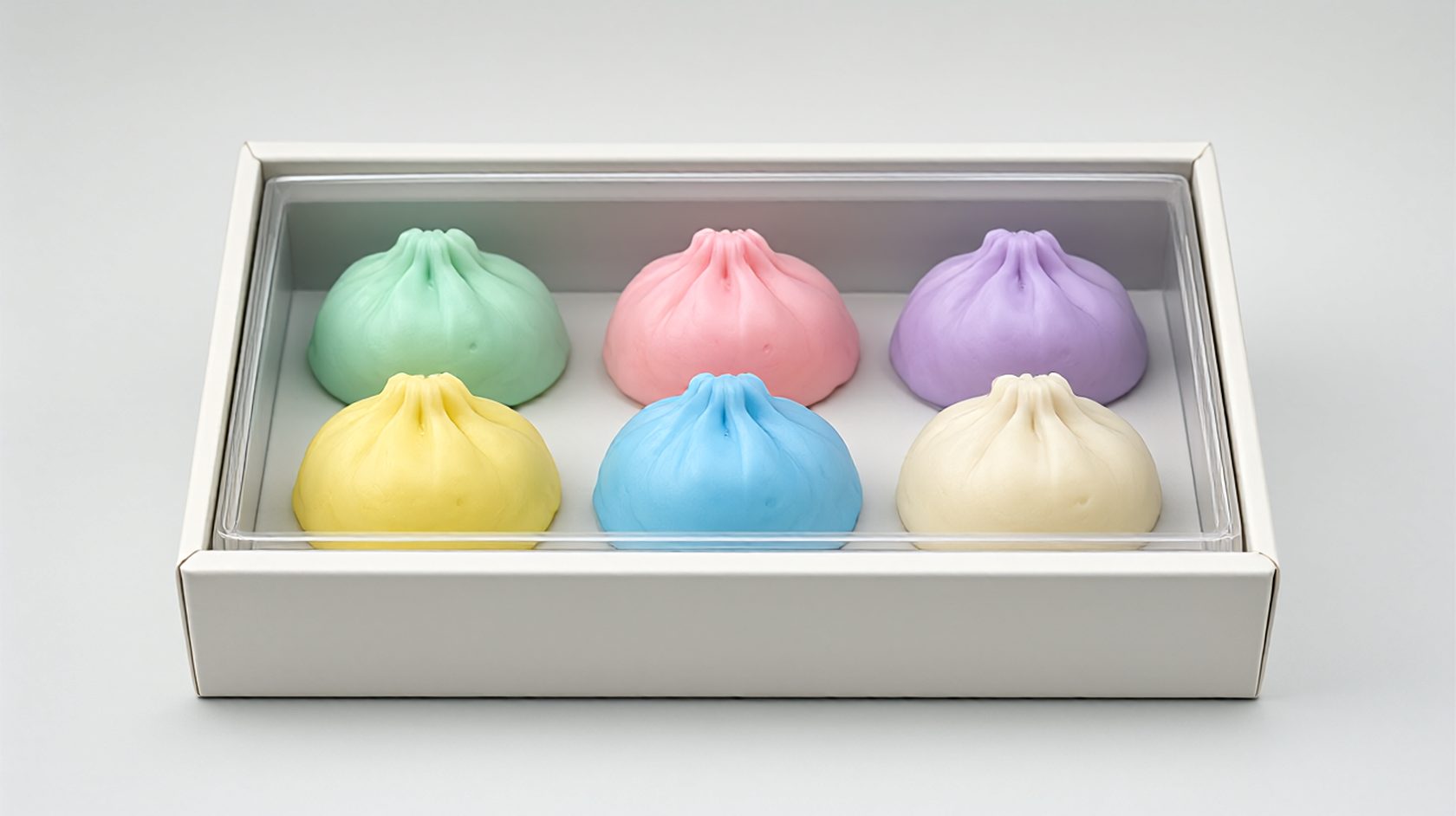
A boxed assortment is a different product
A single squishy is judged on its feel; a box of eight is judged on the box. The customer sees a window, a print and a lid, and the toys inside are evidence rather than the subject.
That reverses the quality priorities. For a single toy the moulding matters most; for a boxed set the window clarity, the retention and the print matter first, because those are what is seen before anything is touched.
The failure that ruins a boxed set is a toy that has moved inside the box, so the window shows a gap and a print that no longer aligns. The movement is a packing problem and it happens in transit rather than in the factory.
So a boxed assortment needs a transit test on the packed box, not a drop test on a toy. The unit under test is the retail pack.
Window film and the soft toy behind it
A window is a film or a printed board with a cut-out, and the film has to stay clear over a soft toy that presses against it. A film that is too thin bulges; one that is too thick hides the texture.
The bulge is the defect that shows first, because the toy is packed with a slight preload to stop it moving. A preload on a soft object is a bulge in the film, and the bulge is visible on a shelf.
The fix is a film with enough stiffness to resist the preload, or a retention that holds the toy away from the film. Both are specified in the pack drawing and neither is specified in a toy drawing.
The check is a visual on the packed box from a metre, under a shop light, looking for a bulge and for a gap between the toy and the film. Both are cosmetic and both are what the retailer rejects.
Counting by cavity and the colour mix
A box of eight usually contains a mix of shapes and colours, and the mix is a counting exercise across several cavities. A box that should contain one of each and contains two of one shape is a box that will be returned.
The count is done by hand at the packing table or by a multi-head counter, and both drift. A hand count drifts with fatigue; a counter drifts with shape similarity, because two dumpling shapes can look alike to a sensor.
The check is a full unpack of a sample of boxes, at the start, the middle and the end of a run, recording the mix by shape and colour. A box that is correct at the start and wrong at the end has a fatigue or a feed problem.
The specification should state the mix per box and per carton, with tolerances at both levels. A mix stated per carton allows eight boxes that are individually wrong and collectively right.
Compression: the load a box of soft toys carries
A soft toy has almost no compression strength, so a stack of boxed sets carries its load through the carton and not through the product. A carton that is too weak is a carton whose boxes deform from the outside in.
The compression test is a stated load for a stated time on a full carton, with the boxes inside inspected afterwards for a deformed window and a displaced toy. A carton that passes the load and fails the inspection has enough strength and not enough structure.
The weakness is usually at the corner rather than the face, because the corner is where the flutes crush first. A carton with a corner post or a heavier liner protects the corner and the window behind it.
The specification should name the board grade, the load and the time, plus the stack height in the warehouse. A board grade without a stack height is a grade chosen for a stack that may not be the real one.
Insert design: pulp, PET or moulded EVA
The insert decides whether a soft toy moves, and the three options are moulded pulp, thermoformed PET and moulded EVA. Each holds differently and each is a different cost and a different environmental claim.
Moulded pulp is cheap, recyclable and soft, and it holds a soft toy by conforming rather than by gripping. It also absorbs moisture and can transfer a paper fibre to the toy's surface.
PET is rigid and clear, and it holds by interference, which on a soft toy means a preload and a possible deformation. It also shows scratches, and a scratched window reads as a used product.
EVA is soft and holds by conforming like pulp, without the fibre transfer. It costs the most and it is the one that leaves a soft toy in the shape it was moulded.
The specification should name the insert material, its fit tolerance against the toy and the retention points. A fit tolerance without retention points allows an insert that holds the wrong part of the toy.
Transit test on the retail pack: the sequence
A boxed set is tested as a retail pack, which means a carton of boxes rather than a box on its own. The sequence is a drop on a corner, a drop on an edge, a vibration and a compression, in that order, because the order reproduces the shipping chain.
The corner drop finds the insert and the window; the vibration finds the count and the mix, because a box that has shifted shows its displacement as a gap; the compression finds the carton.
Each test has its own criterion, and the criteria should be written separately. A pack that survives the drop and fails the vibration has a retention problem rather than a strength problem.
The report should record the drop height, the vibration profile, the compression load and the inspection findings. A report that says the pack passed is a report that cannot be argued with a retailer's own test.
Print registration and the barcode over a curve
A boxed set carries a print that has to register across the window, and a window cut-out makes registration visible. A print that is two millimetres off shows as a border that is uneven on one side only.
The barcode is the other print problem, because a barcode over a curved or a glossy surface scans badly. A barcode that scans at the factory and fails at the till is a barcode placed on a surface that distorts it.
The fix is a flat, matte panel for the barcode, and a print registration tolerance stated as a maximum offset at the window edge. Both are artwork decisions and both are cheap before the plate is made.
The check is a scan test with a verifier at the retail pack, plus a registration measurement at four points around the window. A barcode that verifies at grade B or better is the usual acceptance.
Moisture, the soft toy that swells and the box that sags
A soft toy absorbs moisture from a humid warehouse and swells slightly, and a swollen toy in a fixed insert is a toy that preloads the window. The pack that was correct in the factory is a pack that bulges after a month.
The moisture also softens the carton, and a soft carton is a carton that stacks badly. The combination is a pallet that leans, and the leaning pallet is the one that arrives damaged.
The control is a moisture barrier bag or a desiccant, plus a storage humidity limit. Both add cost, and a set shipped without one is a set whose quality depends on the weather.
The test is a packed box held at eighty-five per cent relative humidity for a week, then inspected for window bulge and carton compression. That condition is not extreme; it is a normal monsoon week.
Dust, static and the soft surface that collects
A soft TPR surface is a dust collector, and a boxed set with a window shows the dust before the toy is touched. Static makes it worse, because the film attracts dust and the dust sits on the inside of the window.
The control is an antistatic additive in the film, or a film that is surface-treated, plus a clean packing area. Both are cheap and neither is in a toy specification.
The check is a visual on a packed box that has been standing for a week, looking at the inside of the window under a raking light. Dust on the inside of the film is a packing environment problem, not a product problem.
The specification should name the film's antistatic treatment and the packing area's cleanliness class, expressed as a simple particle count. A clean room is unnecessary; a covered packing table is not.
The shelf life of a boxed set
A boxed set has a shelf life set by the soft toy's migration and the film's clarity, and both degrade. A set sold after a year on a shelf has a dulled window and an oily toy.
The window dulling is usually a plasticiser from the toy depositing on the film, which is the same migration that stains a shelf. The two failures share a cause, so a migration limit on the toy is also a window clarity measure.
A shelf life of eighteen months is reasonable for a boxed soft set, stated with its storage condition. A set without a shelf life is a set that a distributor will hold until it fails.
The declaration matters for the same reason as on a filled toy: a retailer who is told eighteen months plans a markdown, and one who is told three years returns the pallet.
Eight lines for a boxed soft set
Eight lines cover a boxed set: insert material with fit tolerance and retention points, window film with its stiffness and antistatic treatment, mix per box and per carton with tolerances, board grade with load and stack height, transit sequence with separate criteria, print registration limit at the window edge, barcode grade, and shelf life with storage humidity.
The lines are a pack specification, which is what determines whether a soft toy arrives looking like the sample. The toy's own specification is almost irrelevant once it is inside a box.
The two lines that decide the retail rejection are the window preload and the mix per box, because those are the two visible from outside the pack. Both are measurable before shipment.
Write the eight, keep a golden packed sample, and re-qualify when the insert, the film or the carton grade changes. Those three move all eight.
A boxed set whose window film is specified against the packing preload is the squishy dumpling box, and the preload is what makes a box look full or bulged.
- 01Insert material named with fit tolerance and retention points.
- 02Window film stiffness checked against the packing preload; no bulge at one metre.
- 03Mix stated per box and per carton, with a tolerance at each level.
- 04Board grade with compression load, time and warehouse stack height.
- 05Transit sequence on the retail pack: corner drop, edge drop, vibration, compression.
- 06Print registration limit measured at four points around the window.
- 07Barcode verified at grade B or better on the finished pack.
- 08Humidity hold at eighty-five per cent for a week, then window and carton inspected.