Maltose-filled squishy toys: the filling is a food, and that is the whole problem
A maltose core gives a squishy its slow recovery. It also makes the toy a food-contact article with a shelf life, and most specifications ignore both.
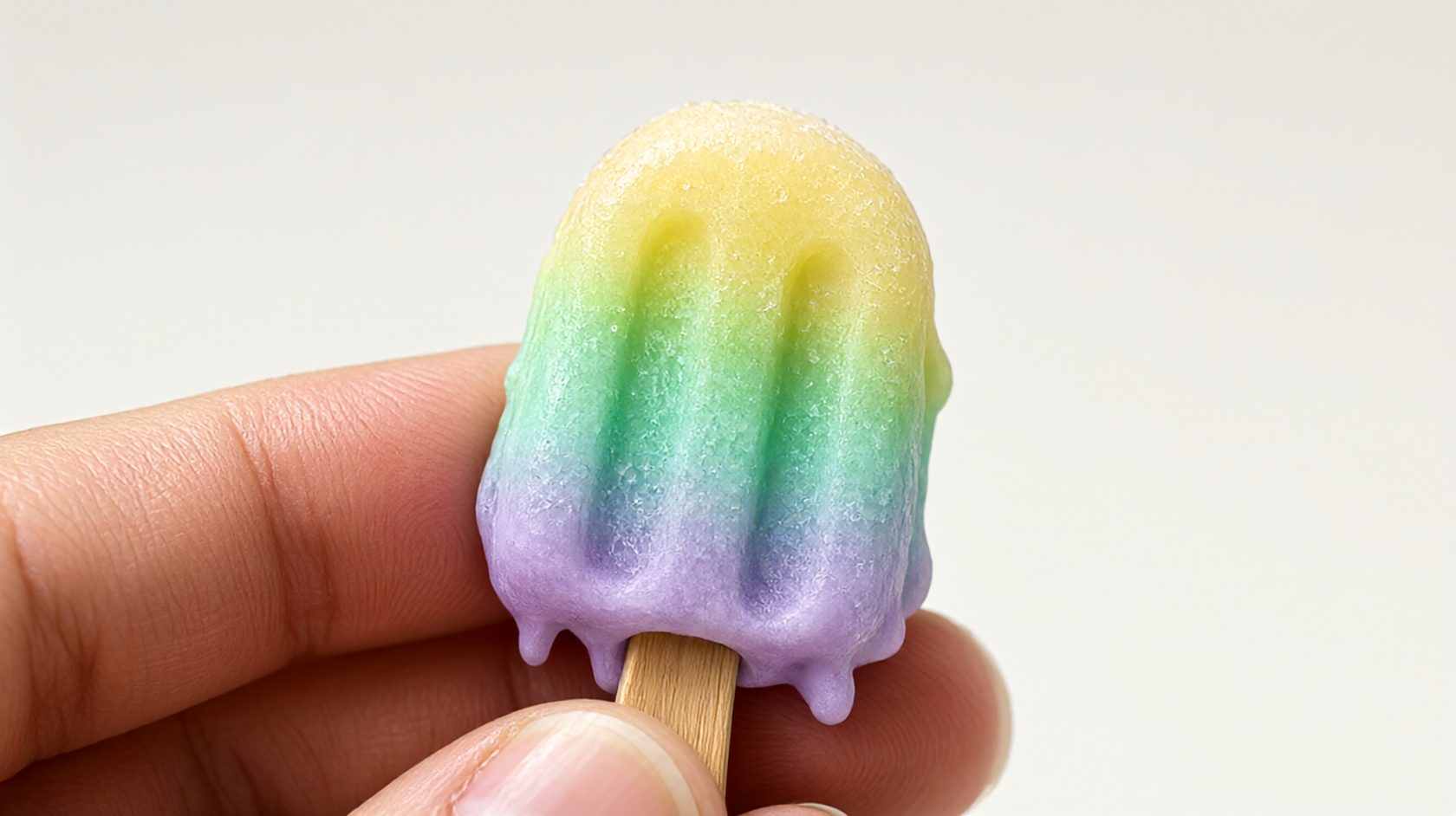
What maltose does that TPR cannot
A maltose-filled squishy is a soft shell around a viscous sugar core, and the core is what produces the slow, doughy recovery that a solid TPR toy cannot imitate. The shell deforms, the core flows, and the shape comes back over seconds rather than instantly.
The behaviour is a rheology property, not a design trick. Maltose syrup at the water content used in toys is a shear-thinning fluid with a viscosity that falls by orders of magnitude as the shell is squeezed, which is why the toy feels soft at first and then firms up.
That also means the feel is a function of temperature. A toy that is doughy at twenty degrees becomes sluggish at five and nearly rigid at thirty-five, and a specification written without a temperature is describing one of those three toys.
The core is also a food ingredient. Maltose syrup has a water content, a sugar profile and a microbiological load, and a toy that contains it is a food-contact article in most regulatory readings even though nobody eats it.
The shell is the containment, so its gauge is a safety figure
The shell is usually TPR or a soft PVC, blow-moulded or dipped, and its wall thickness is the only thing between a child's teeth and the syrup. A shell at 0.6 mm is a toy; a shell at 0.3 mm is a pouch.
The failure mode is not a puncture but a fatigue crack at the seam, which starts where the shell was stretched most during filling. A toy that leaks at the seam after a hundred squeezes was filled through a neck that was too small for the fill pressure.
The gauge should be specified as a minimum at the thinnest point after filling, not as a nominal, because the fill pressure stretches the neck. A nominal 0.6 mm shell that measures 0.42 mm at the neck has lost a third of its section to the process.
The check is a section through the filled toy at the neck and at the equator, with the wall measured at four points. It costs one toy per lot and it is the only measurement that predicts a leak.
Water activity, not water content
Maltose syrup is specified by its water content, and the figure that decides whether the filling will ferment is water activity. The two move together but not identically, and a supplier can meet a water content figure with a syrup that has the wrong activity.
Water activity above about 0.6 supports mould and yeast, and a sealed toy is a warm, humid chamber. A filling at 0.55 is stable; one at 0.65 will develop a gas bubble and an off smell within a season, and the customer will describe it as a rotten toy.
The activity is set by the sugar profile as much as by the water, because maltose and higher saccharides bind water more strongly than glucose. That is why a high-maltose syrup at the same water content is more stable than a glucose-heavy one.
The specification should state water activity with its measurement temperature, plus a microbiological count on the incoming syrup. A certificate of analysis that gives only Brix is a certificate that says nothing about stability.
Preservation and the claim that has to travel
A food-ingredient core needs a preservation decision: a preservative, a thermal treatment, or a water activity low enough that neither is needed. Each choice has a cost and each one has a regulatory consequence.
A preservative in a toy is a substance in a children's article, so it enters the toy chemical review rather than the food review. A permitted food preservative may be an unnecessary chemical in a toy, and the two frameworks do not agree on the same list.
The cleanest route for export is a high-solids filling at a water activity below the microbial threshold, with no preservative and a pasteurised fill. It costs more per kilogram and it removes a whole compliance argument.
Whatever the route, the claim has to travel with the shipment: the syrup specification, the activity result, the microbiological result and the fill temperature record. A toy without those four is a toy whose core is undocumented.
Temperature cycling and the phase change
A maltose filling crystallises when it is held cold and diluted when it absorbs moisture, and both change the feel. A toy shipped in a container through a cold route can arrive with a grainy core, which reads to the customer as a defective product.
The crystallisation is reversible with warmth, which is why the complaint often resolves itself and the supplier concludes there was no problem. The toy did change, and it will change again in the next cold season.
The relevant test is a cycle between five and thirty-five degrees, ten times, with a squeeze test and a visual check at each end. A core that goes grainy at five and does not fully clear at thirty-five has a sugar profile that is too glucose-heavy.
Glass transition and crystallisation are slow processes, so a single cycle proves little. The test has to be repeated, and the pass criterion has to be a feel rather than a photograph.
Seal integrity: the neck, the plug and the secondary seal
A filled squishy is closed by a plug, a cap, or a welded seam, and each closure has a different leak path. The plug leaks at its interference fit; the cap leaks at its thread; the weld leaks at its heat-affected zone.
The plug is the cheapest closure and the most sensitive to mould shrinkage, because the interference that holds it is a few hundredths of a millimetre. A plug that fits at twenty degrees can loosen at thirty-five when the shell softens.
A secondary seal, usually a solvent or a hot-melt around the plug, converts the interference fit into a barrier. It also adds a chemical to the toy, so the sealant has to be in the toy chemical review along with the preservative question.
The leak test is a squeeze under water: ten squeezes, looking for a bubble at the closure. A toy that bubbles on the first squeeze has a closure problem; one that bubbles on the tenth has a fatigue problem at the neck.
The shelf life nobody writes down
A filled toy has a shelf life whether or not it is declared, because the core is a food ingredient and the shell is a polymer that plasticises. A toy held for two years in a warehouse is not the toy that was qualified.
The two clocks run at different rates. The core loses activity stability slowly; the shell absorbs plasticiser from the core and softens faster, which shows as a toy that has become flabby and prone to tearing at the neck.
A shelf life of eighteen months is typical, and it should be stated with the storage condition, because a pallet in a hot warehouse ages the toy at several times the rate of a cool one.
The declaration matters commercially: a retailer who is told eighteen months orders differently from one who is told three years, and the second retailer will return the pallet at month nineteen.
Flavour, smell and the sensory complaint
A sugar core can develop an off smell before it fails any physical test, and smell is the complaint that arrives first because it needs no instrument. A toy that smells fermented has already failed, whatever the activity figure says.
The smell usually comes from the closure rather than the core, because the closure is where moisture enters and where anaerobic conditions develop. A toy with a leaking plug smells before it leaks visibly.
The sensory test is a trained panel or, more practically, a sealed-jar incubation: hold the toy in a closed jar at thirty-five degrees for a week and open it. A smell that reads as alcohol or vinegar is a fermentation that no activity certificate predicted.
The specification should include the jar test with its temperature and duration, because it is the only test that reproduces the retail packaging condition. A toy tested open on a bench is a toy tested in the wrong environment.
Age grading and the small parts question
A maltose-filled toy is soft, squeezable and small enough to enter a mouth, so its age grading is the first regulatory decision. Under three years it is a toy for children who mouth everything; over three it is a toy that still gets mouthed.
The core raises a specific question: if the shell is breached, the contents are a small-part-sized mass of edible material. That is not a small parts failure under the standard, but it is a choking and a hygiene event, and a risk assessment has to say so.
The practical answer is a shell that resists a bite at the tested force, plus an age grading that reflects it. A toy sold to three-year-olds with a 0.4 mm shell is a toy whose grading was decided by marketing.
The bite test is a simulated incisor at a stated force, applied at the neck and the equator, on ten samples. A shell that survives ten bites has an evidence base; one that survives none has a redesign.
The filling specification, in eight lines
Eight lines cover a maltose filling: sugar profile with the maltose fraction, water content and water activity with the measurement temperature, microbiological limits, fill temperature, preservative decision, closure type with its sealant, shelf life with storage condition, and the jar smell test.
The lines are unusual for a toy because most of them are food lines. That is the point: the core is a food, and a toy specification that treats it as a generic gel is a specification with a blind spot at its centre.
The two lines that decide the complaint rate are water activity and the closure, because those are the two that a bench test does not reproduce. Both are cheap to measure and both are usually missing.
Write the eight, keep a retained sample from each filling lot, and re-qualify when the syrup supplier, the closure or the shell gauge changes. Those three move all eight at once.
The toy whose filling is specified by water activity rather than by Brix is the maltose-filled popsicle squishy, and that one figure is what separates a stable core from a fermenting one.
- 01Sugar profile stated with the maltose fraction, not only a Brix figure.
- 02Water activity given with its measurement temperature; target below 0.6.
- 03Microbiological limits on the incoming syrup with a certificate of analysis.
- 04Fill temperature recorded per lot; pasteurised fill stated if used.
- 05Preservative decision documented against the toy chemical review, not the food list.
- 06Minimum shell gauge after filling measured at the neck and the equator.
- 07Squeeze leak test under water, ten squeezes, at the closure.
- 08Sealed-jar incubation at thirty-five degrees for a week, opened and smelled.