Paint on a soft banana: adhesion on a substrate that stretches under the ink
A painted TPR toy fails at the paint, not at the moulding. The reasons are a flexible substrate, a rigid ink and a cure that never reaches the interface.
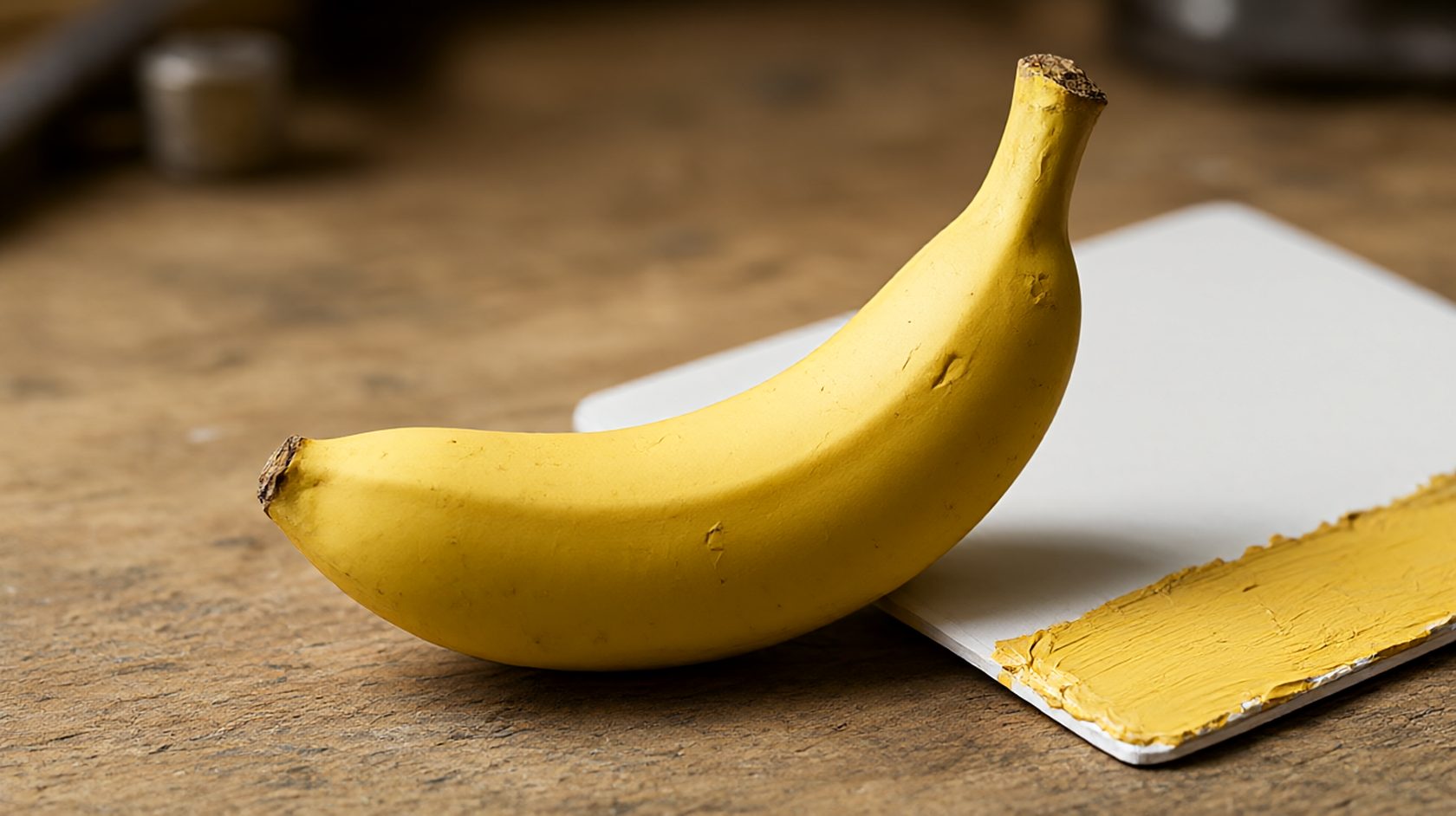
Why paint behaves differently on TPR
Paint adheres by mechanical keying and by chemical compatibility, and a TPR surface offers little of either. It is smooth, it is non-polar, and it releases oil that migrates to the interface.
The oil migration is the specific problem: a coat applied to a freshly moulded toy sits on a film of oil, and the adhesion is to the oil rather than to the polymer. The coat looks good and peels at the first squeeze.
The second problem is modulus. A rigid ink on a substrate that stretches by fifty per cent has to elongate with it, and an ink that cannot will crack at the film's internal cohesion rather than at the interface.
Both problems are solved at the ink and the surface preparation rather than at the application, which is why a paint complaint is rarely fixed by the painter.
Surface preparation: the wipe, the flame and the primer
The three preparation routes are a solvent wipe, a flame or plasma treatment, and a primer. The wipe removes oil and does not change the surface energy; the flame and the plasma raise the energy; the primer does both.
A solvent wipe on TPR is a moving target, because the oil returns. A toy wiped and painted within an hour adheres; the same toy wiped and painted the next day does not, and the difference is invisible on the line.
Flame treatment is fast and inconsistent: it oxidises the surface and it also heat-ages the oil, and an over-flamed surface reads as a gloss change. The window between under-treated and over-treated is narrow.
A primer is the most controllable route and the most expensive, because it adds a step and a chemical to the toy. Its advantage is that the primer can be formulated for the specific TPR grade rather than for the family.
Ink chemistry: flexibilised systems and the cure
The ink has to be flexibilised, which means a resin system with a plasticiser or a soft segment that lets the film elongate. A standard rigid ink will fail a stretch test regardless of adhesion.
Cure is the second variable: a two-component ink cures by reaction and a one-component ink by solvent loss. A two-component ink that is mixed at the wrong ratio cures hard and brittle; one mixed correctly stays flexible.
The cure also has to reach the interface. A film that skins over quickly traps solvent at the substrate, and the trapped solvent is a release layer. That is why a thick coat adheres worse than a thin one.
The specification should name the ink system, its mix ratio, its film thickness range and its cure condition. A paint specification that names a colour and a gloss is a specification of an appearance.
The tape test that has to be run after a stretch
A cross-hatch tape pull on a flat, unpainted-stretch sample tests the wrong thing. The failure that matters happens when the toy is squeezed, so the test has to include the stretch.
The practical sequence is: paint, cure, stretch the painted area by a stated percentage, release, then cross-hatch and tape pull. A coat that passes before the stretch and fails after has a cohesion problem, not an adhesion problem.
The result is graded against a standard scale, and the grade should be stated as a number rather than as a word. A pass described as good adhesion cannot be argued with a supplier who calls a grade three good.
The test should be repeated after an accelerated age, because a coat that passes new can fail after a month of oil migration. Ageing at fifty degrees for a week is a reasonable proxy for a season on a shelf.
Bleed-through and the halo at the edge
A painted soft toy often shows a halo where the pigment from the base migrates into the coat, or where the coat's solvent attacks the base pigment. The halo is a diffusion problem between two polymers.
The halo appears at the edge of the painted area first, because that is where the coat is thinnest and the base is exposed. A toy with a halo looks hand-painted badly, and it is a chemistry mismatch.
The fix is a barrier primer or a pigment system in the base that does not migrate. A pigment with a larger particle size migrates less, and it also disperses worse, which is the trade.
The check is a visual under a raking light after ageing, looking at the boundary between painted and unpainted areas. A halo that is visible at arm's length is a reject for a retail toy.
Colour on a translucent base
A translucent TPR base shows the paint differently from an opaque one, because light passes through the base and returns through the coat. The same coat reads warmer on a yellow base and cooler on a blue one.
The consequence is that a colour matched on an opaque plaque is wrong on the toy, and the error is largest for light colours with a low opacity coat. A pastel on a translucent base needs a white base coat.
A base coat adds a step, a film thickness and a failure mode, because the base coat is now the layer that has to adhere. It also improves opacity, which lets the top coat be thinner and more flexible.
The specification should state whether the colour is on a base coat, and should give the film thickness of each layer. A colour specified without a layer structure is a colour that will be matched by trial and error.
Edge coverage and the paint that misses the crease
A soft toy has creases and the paint has to reach into them, and a spray or a dip that misses the crease leaves an unpainted line that opens when the toy is squeezed. The line is invisible on a new toy and obvious after a week of handling.
Dip coating covers creases better than spray, because the liquid fills the crease. Dip also gives a thicker film on the low points, which is where runs form, so dip needs a drainage orientation.
The check is to squeeze the toy and look at the crease under a light. An unpainted line that appears only when squeezed is a coverage failure that a flat inspection will not catch.
The specification should name the application method and the coverage criterion, expressed as a squeeze test rather than as a visual on a flat surface.
Plasticiser migration into the coat
The oil in the TPR migrates into the paint film over time, and the film softens and then becomes tacky. A tacky painted toy picks up dust and sticks to its own packaging.
The migration rate depends on the oil and on the film's crosslink density, so a more crosslinked film resists migration longer. That is the argument for a two-component system even when a one-component one passes at day one.
The test is a tack check after ageing: touch the painted surface with a clean finger at a stated pressure and look for a mark. A film that marks after a week at fifty degrees will be tacky on a shelf in a season.
The specification should require the tack check as part of the ageing protocol, because it is the only test that catches the failure the customer feels rather than sees.
Legal limits on what the paint may contain
Toy paint is heavily regulated: heavy metals, phthalates and, in some markets, a limit on the total of certain elements. The paint is the part of the toy most likely to fail a chemical test, because it is a thin film with a high pigment loading.
A pigment that meets the colour and fails the heavy-metal limit is a pigment that cannot be used, and the two properties are unrelated. The only way to know is a test on the finished film rather than on the pigment.
The test is an acid digestion of the dried film with an elemental analysis, against the limits of the target market. Testing the wet paint is not sufficient, because the film can concentrate an element.
The specification must reference the finished-film test and the market, and the compliance file has to keep the result per colour and per supplier. A file organized by toy rather than by colour will miss the one colour that fails.
Eight lines for a painted soft toy
Eight lines carry a painted TPR toy: substrate grade, surface preparation method with a time limit between preparation and paint, ink system with its mix ratio, film thickness per layer, cure condition, stretch adhesion grade, ageing protocol with a tack check, and finished-film elemental limits.
The lines are all interface lines, which is what a paint system is: a substrate, a preparation, a film and a cure, in that order, with a failure mode at each boundary.
The two lines that decide the complaint rate are the preparation time limit and the stretch adhesion, because those are the two that a same-day inspection will pass and a season will fail.
Write the eight, keep one painted reference per colour, and re-qualify when the TPR grade, the ink or the primer changes. Those three move all eight.
A painted toy whose adhesion is graded after a stretch is the TPR banana squishy, and the stretch is the only condition that predicts a coat failing on a shelf.
- 01Substrate grade named; surface preparation method stated with a time limit to paint.
- 02Ink system with its mix ratio and film thickness range per layer.
- 03Cure condition stated as time and temperature, not only as a line speed.
- 04Adhesion graded after a stretch of a stated percentage, not on a flat sample.
- 05Ageing at fifty degrees for a week, then adhesion and tack checked again.
- 06Squeeze test for crease coverage; no unpainted line appears when squeezed.
- 07Halo check at the boundary under raking light, at arm's length.
- 08Finished-film elemental analysis per colour, against the target market limits.