TPR rabbits: shrinkage, tool texture and the surface that decides the hand feel
A soft TPR figure is a moulding problem before it is a design. The tool sets the texture, the shrinkage sets the size, and the two fight each other.
TPR is not one material
Thermoplastic rubber covers a family of styrenic block copolymers blended with oil and fillers, and two TPR toys that feel identical can differ by thirty Shore A points in hardness and by a factor in shrinkage.
The hardness is set by the oil-to-polymer ratio, and the oil is also what makes the material plasticise, stain and smell. A softer toy has more oil, which means more migration and a shorter surface life.
The shrinkage is set by the same ratio plus the filler, and it ranges from about one per cent to three per cent depending on the grade. A tool cut for one grade will produce a figure that is visibly wrong when the grade changes.
So a TPR toy specification has three numbers before the shape: hardness in Shore A, oil content or a migration limit, and shrinkage with its test condition. Without those three the drawing describes a silhouette and not a material.
Shrinkage and the tool that was cut for another grade
Shrinkage in TPR is anisotropic: it is larger across the flow than along it, because the polymer chains orient during filling. A tool compensated with a single figure will produce a figure that is oval rather than small.
The practical consequence is that a round face moulded in a rectangular gate becomes an ellipse, and the eyes printed on it no longer line up. The defect is read as a print problem and it is a tool compensation problem.
The compensation should be measured on a trial tool with a grid of dimensions in both directions, and the tool then cut with two figures. A tool cut with one figure is a tool that will be re-cut once the first samples are measured.
Shrinkage also changes with wall thickness, because a thick section cools more slowly and shrinks more. A figure with a thick body and thin ears shrinks unevenly, and the ears pull the face out of shape.
Tool texture: the hand feel is a mould finish
Soft toys are almost never smooth; the surface has a fine grain that gives grip and hides flow marks. That grain is etched into the tool, and its depth and pattern are what the hand reads as quality.
The grain is produced by acid etching or by laser, and both are specified in a standard scale. A grain that is too fine reads as plastic; one that is too coarse reads as cheap and collects dirt.
The grain also affects ejection. A deep grain holds the part on the core, so the ejector pins have to be larger or the draft has to be steeper, and a shallow draft with a deep grain is a part that tears on ejection.
The specification should name the grain standard and its depth, plus the draft on the textured surfaces. Naming a texture without a draft is naming half of a moulding condition.
Draft, ejection and the tear at the ear
The failure that ruins a soft figure is a tear at a thin appendage, and it almost always starts at ejection rather than in service. An ear with a one-degree draft and a textured surface is a part that the ejector has to push off.
Soft materials tolerate a smaller draft than rigid ones because they flex, but they also grip the tool more, so the net requirement is not lower. A one-degree draft is normal for a smooth surface and marginal for a grained one.
The tear starts at the point where the part is still stuck while the rest has moved, which is usually the deepest grain or the thinnest section. A tear at the ear root is a tool problem that no material change fixes.
The check is to inspect the first-off parts at the ear root under a low raking light. A white stress line at the root is a part that will tear in the field, and it is visible before any test.
Hardness, oil and the migration that stains
A soft TPR figure left on a painted shelf leaves an oily mark, and that mark is plasticiser migration. The oil that makes the toy soft is the oil that leaves it, and the rate depends on the oil's molecular weight and the storage temperature.
Migration shows as a gloss loss on the toy and a stain on whatever it touches. A toy that has been in a warm window for a month will have a dull surface and a greasy feel, and the customer reads both as ageing.
The test is a paper or a lacquered panel in contact with the toy at an elevated temperature for a stated time, with the stain measured. A toy that stains a lacquered panel at fifty degrees will stain a shelf at thirty.
The specification should limit the migration rather than the oil content, because the oil content that produces a given migration depends on the oil grade. A limit on the oil alone can be met with a light oil that migrates more.
Surface printing on a soft substrate
Eyes, cheeks and patterns on a soft figure are printed, pad-printed or transferred, and a soft substrate is the hardest to print because it moves under the pad and stretches after printing.
The print's adhesion is tested by a tape pull and by a rub, and both should be run after a stretch, because a print that survives a flat pull can fail when the toy is squeezed. This is the failure that appears as a decal that peels at the cheek.
The ink also has to flex with the substrate. A rigid ink on a soft toy cracks at the first squeeze, and the crack shows as a white line through the colour. A flexible ink costs more and is the only one that survives.
The specification should name the ink system, the cure and the adhesion test with its stretch condition. A print specification that names a colour and not an ink is a specification of an appearance.
Colour matching across a soft material
Colour in TPR is produced by pigment in a translucent base, so the same pigment loading reads lighter on a thin section and darker on a thick one. A figure with thick ears and a thin face will show a gradient that looks like a print problem.
The effect is light scattering rather than pigment concentration, and it is worse in soft grades because the oil increases translucency. A colour matched on a plaque is not the colour on a three-millimetre ear.
The match should be made on a production part at the thinnest and the thickest section, and the acceptance should be a colour difference at both. A single measurement on the body hides the gradient that the customer sees.
Pigment selection also matters for migration: some pigments bleed into the oil and produce a halo around the print. The halo is a pigment choice, and it is visible within a month on a warm shelf.
Smell: the oil, the cure and the sealed bag
A soft toy in a sealed bag develops a smell that disappears after a day in air, and the smell is the reason a retail buyer rejects a lot. It is not a defect in the material but a consequence of packaging.
The smell comes from volatile oil fractions and from any residual monomer or curing agent, held in the bag and concentrated. A toy that smells on opening has been packed too soon after moulding, before the volatiles had time to leave.
The fix is a dwell time between moulding and packing, or a ventilation step, and both cost floor space. The alternative is a lower-volatility oil, which costs material.
The test is a sealed bag at forty degrees for forty-eight hours, opened and assessed by a panel. A bag test that passes at ambient and fails at forty is a bag test that was run at the wrong temperature.
Bite and tear resistance at the appendages
A soft figure is bitten at the ears and the limbs, and the relevant property is tear strength rather than tensile strength. A material with a high tensile and a low tear will snap at the ear root where a lower-tensile, higher-tear grade would bend.
Tear strength in TPR is improved by the polymer grade and by the filler, and it falls as the oil content rises. The softest toys are the least tear resistant, which is the trade a designer makes when specifying hardness.
The test is a trouser tear on a moulded specimen, plus a field test of a bite at the ear on ten samples. The field test is the one that predicts the complaint, because the specimen does not have the ear's geometry.
The pass criterion should be no tear at the ear root after the bite, plus a trouser tear above a stated figure. Both are needed: the specimen predicts the material and the bite predicts the part.
Packing a soft figure without deforming it
A soft figure packed in a rigid blister is held by its extremities and deforms under the retention. A toy that has been squeezed for a month arrives with a flattened ear that recovers slowly, and the customer sees it as damaged.
The fix is a blister that holds the body and leaves the appendages free, or a moulded pulp that supports from behind. Both cost more than a flat card and both prevent the most common cosmetic complaint on a soft toy.
The carton also has to resist compression, because a soft toy in a stack takes the load through its own body. A stack of ten soft figures in a weak carton is ten figures with flattened faces.
The packing specification should name the retention points, the carton grade and the stack height. A spec that names the carton size and not the retention is a spec that allows the deformation.
Eight lines for a TPR figure
Eight lines carry a soft TPR figure: hardness in Shore A, shrinkage in two directions with its test condition, tool grain standard and depth, draft on textured surfaces, migration limit against a lacquered panel, ink system with a stretch adhesion test, colour difference at thin and thick sections, and tear plus bite criteria.
The lines are unusual because six of the eight are tool or process figures rather than material properties. That reflects what a soft toy is: a moulding whose feel, size and durability are decided at the tool.
The two lines that decide returns are the draft and the migration, because those produce the tear and the stain. Both are measurable before the first shipment.
Write the eight, keep a first-off from each cavity, and re-qualify when the TPR grade, the tool grain or the ink changes. Those three move all eight.
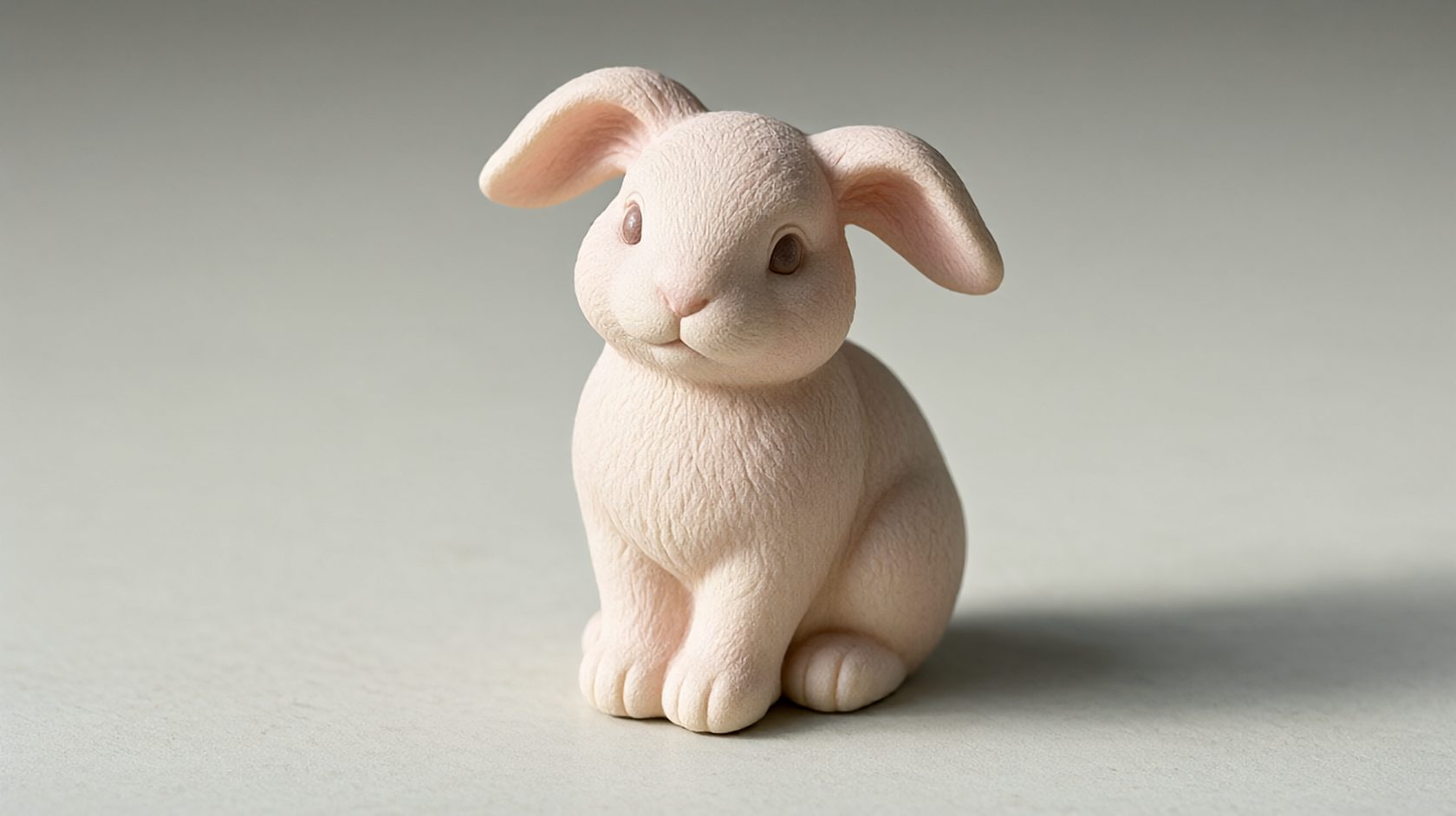
A figure whose tool grain and draft are both published is the TPR rabbit squishy, and those two numbers decide whether the ear tears on ejection or in a hand.
- 01Hardness in Shore A, plus oil content or a migration limit.
- 02Shrinkage measured in two directions on a trial tool, before the production tool is cut.
- 03Tool grain named from a standard with its depth.
- 04Draft on textured surfaces stated; a one-degree draft is marginal on a grained face.
- 05First-off inspection at the ear root under raking light, no white stress line.
- 06Migration tested against a lacquered panel at an elevated temperature.
- 07Ink system named with an adhesion test after stretch, not only a flat tape pull.
- 08Sealed bag at forty degrees for forty-eight hours, opened and assessed for smell.